A Summer of Research and Collaboration: My CRA-NSF CISE REU Experience, by Saanvi Kunisetty
- Article by Andrew Fullard
- 14th Aug, 2026
This summer, I was selected to participate in a CRA-supported REU through NSF CISE at the Kerzendorf Lab, an experience that shaped both my technical training and my understanding of what scientific research looks like in practice. As a student with a highly interdisciplinary background with double majors in Astronomy + Data Science and Biology and minors in Computer Science and Chemistry, I was particularly excited by the way this project meshed together computational modeling, physical interpretation, and open scientific software.
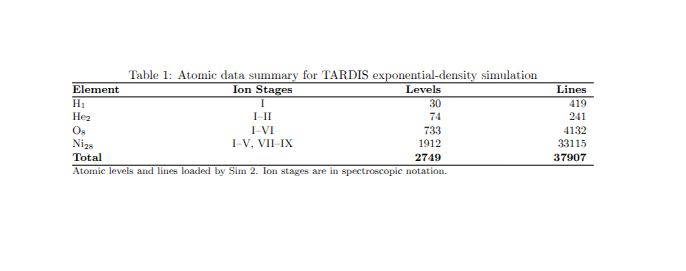
My work involved two projects aimed at making TARDIS more accessible and useful to researchers. First, I reorganized and expanded the developer documentation, creating clearer categories for setup, code structure, testing, collaboration, reproducibility, and documentation practices. I converted the material into TARDIS's Sphinx documentation format, integrated it into the website structure, and revised it using contributor feedback. Second, I developed an atomic-data table generator that summarizes the energy levels, ionization stages, and spectral lines used in TARDIS simulations. After prototyping the tool with Carsus atomic data, I migrated it into TARDIS and added support for multiple inputs, selected elements, journal-specific LaTeX styles, plain-text output, custom templates, and automated tests. Together, these projects improve the usability, reproducibility, and transparency of the TARDIS research software.
What I appreciated the most about this summer goes further than the project work, though. My time at MSU was shaped by the graduate students and postdocs in the lab who were generous with their time and always eager to help me learn. Team lunches at Angela's café and Friday evening conversations in the office room after a science meeting became part of the learning experience itself. These moments gave me a sense of how a research group transforms into your community.
I was especially influenced by Wolfgang Kerzendorf and Andrew Fullard. Wolfgang showed me how to take on projects that are new , challenging, and maybe unfamiliar, and Andrew's guidance helped me slowly refine my work and develop efficient coding and documentation skills week by week.
Ultimately, this REU deepened my passion for computing and astrophysics while also cementing my interest in interdisciplinary science. I have long been drawn to the intersection of natural sciences and programming, and this experience confirmed that I want to pursue research in that area. I am especiallyinterested in how astrobiological discoveries can be aided by computational science, and this summer helped that dream feel a little closer than before.